Saturday, 16 March 2019

Torres del Piaine, Chile

Ok, so I messed up.  This blog should follow El Calafate but things got muddled and I can't work out how to change its position.  Sorry, some scrolling will be needed.

=======================================================================


Only the very faintest promise of dawn showed as we left El Calafate in the minibus that would take us to our next destination.  We had the road pretty much to ourselves, as very slowly night turned into day.


Formalities at the Argentine border were completed quickly and we drove for several kilometres across no-mans-land until we reached Chilean immigration.  Organised chaos may best describe the immigration process but eventually we made it through; forms completed, passports stamped (now that’s a rarity these days) and baggage x-rayed.  We left on a brand new concrete road that ran out after about half a kilometre and it was a dirt road for a while.  But it was a good dirt road and we’re used to those, so no complaints.  Then it was back to a first class concrete road until we reached the Torres del Paine (pronounced pie-ney) National Park.  The scenery remained as it had been for a while - mountains, hills and low scrub – not entirely unlike the Australian bush, but more green.  We found out that Paine actually means blue.  It’s taken from the colour of the glacier ice and a bluish haze that appears over the steppes.

We spotted the first guanacos, (wan-ar-cos) a wild versions of the domesticated llama, and somewhat smaller.  These animals are native to the region, breed prolifically and are the main prey for the puma (which we didn’t see).  They’re attractive creatures.  Some are in small herds, mostly females with a dominant male while others are solitary, generally younger males.  These frequent the hilltops and perform vital sentinel services by warning the herds of any potential dangers.


Our hotel, Las Torres, was gloriously located at the base of Monte Almirante Nieto (2670 metres) in the Torres del Paine National Park.  The national park has been described as the eighth wonder of the world.  Sometimes the view was clear, at other times it was lost in the clouds.  At all times it was extraordinary, verging on breathtaking.


 We were fortunate to come across some grey fox cubs playing amongst the grass hillocks.  They were entirely unconcerned about their audience.  And then a real thrill, condors flying overhead.  These enormous birds have a wingspan of three metres, making them the largest flying land bird, and the second largest bird (the albatross has the longest wingspan at around four metres).  They’re carrion and can gorge on up to five kilograms of meat and still take off, although with some difficulty.  We thought them magnificent and a camera with a better lens  than ours is needed to really do them justice.


Then it was more mountains, lakes, fast flowing rivers and us keeping an eye on the weather, which changed in minutes.  Warm sunshine to rain as the clouds descended in moments.  Each time we looked at a mountain it seemed to appear in a different form, or disappeared completely.  But  the air was clear, clean and cold, and that made us feel wonderfully alive.


The Las Torres hotel offers twenty five different excursions, all included as part of the package.  We avoided the horse riding and opted for five of them.  Firstly, an all-day tour; bus, half an hour in a Zodiac, some hiking, another 1½ hours in another Zodiac, finally another hike.  Finally we arrived at the Serrano Glacier.  Wonderful.  The journey was worth it.  Then we had to return the way we came.  Four hours in a Zodiac is tough on the nether regions!


During the three hiking tours to the surrounding terrain we saw a giant woodpecker (no decent pic unfortunately) working diligently on a tree, many more guanacos, varieties of duck, swan, goose and a host of smaller birds.  And Kim was in her element with the variety of plants and shrubs.  Our visit to the hotel’s organic vegetable garden, the only such place for hundreds of kilometres, was fascinating.  About 30% of the fresh food served in the hotel is produced there.  We thought that impressive given the climate.  Food and drink were plentiful and the hotel staff treated us royally with lovely touches that demonstrated a genuine level of thoughtfulness – tea from a thermos on the top of a hill in the middle of a hike, chocolate bars for instant energy after a long trek.  Stops for a rest at regular intervals on a hike.  With advancing years, these touches are appreciated.  Altogether a wonderful experience.


All too soon the days passed and we were scheduled to move on.  The mini-bus was there to collect us sharp at 1pm for the 6 hour journey to Punta Arenas.  We’re going south once again.  Goodbye Torres del Paine and thankyou.


Friday, 15 March 2019

Punta Arenas


After what turned out to be quite a long and fairly tiring road trip, a hot dinner was welcome.  Lots of fresh scallops, large portions of poached salmon, veggies and a Chilean sauvignon blanc definitely hit the spot.  The presented bill was for 55,000 pesos.  I can’t recall ever seeing such a big number on a food bill before, it even overflowed the box intended to show the total.  Happily that number of pesos amounted to 82 US dollars.  Panic over.
 

A good night’s kip and the first lazy start to the day was most welcome.  An equally lazy breakfast, a stroll around the city centre, coffee in a lovely little café and our batteries were recharged, ready for tomorrow.

Punta Arenas is the capital city of Chile’s southernmost region with a population a little in excess of 160,000.  The name means Sandy Point, and yes there is sand although it’s a dull grey colour, rather than the gleaming white shown on postcards of exotic locations.  The city is noted for its strong winds that can reach 130 km/h [81 mph].  It’s also affected directly by the by the thinning ozone layer with permanent residents considered to be exposed to damaging levels of ultra-violet radiation.  Better keep my hat on then.

There’s interesting contrast between the two extremes of buildings.  At the top end, mansions of the very wealthy are opulent and beautifully built in brick, although where they found the skills to create such places remains a mystery.  At the other end, many of the cottages are simple wooden structures with brightly coloured corrugated iron roofs and walls covered with sheets of metal.  We had significant doubts about the insulative qualities of some of these places.  The contrast between the super-wealthy, grown rich on cattle raising and mining, and the average poor was extreme to say the least.


 The Museo Victoria is a yard on the seafront with full size replicas of several ships and boats.  Ferdinand Magellan’s ship, the Victoria, was the first to complete a world circumnavigation in the early 1500s, a remarkable achievement for the time.  Perhaps the most poignant was Shackleton's 20 ft long longboat, the James Caird, in which he and five others made the extraordinary journey in mid-winter from the Antarctic to Elephant Island in 1916 after their ship, the Endurance, was crushed in the ice.  The story is well documented so I’ll simply refer you to the internet to find out more about their courage and determination that exceeded what most of us are capable of achieving.


 The full size replica of the Beagle, the ship in which Charles Darwin explored the southern hemisphere, collected plants and seeds, and consolidated his ideas that would be published in his tome ‘On the Origin of Species’.  We’re not too sure about the representation of the figurehead but reckon our own beagle dog would not be very impressed.  The ship was interesting although I was doubtful that so much synthetic rope rigging was used in those days.


  We liked Punta Arenas.  We liked the homely feel of the place.  We liked the quirky street signs and the many statues to Magellan and other seafarers.  Kim especially liked the little market stalls, and we both liked La Chocolatta, the cosy coffee shop that made fresh churros and served coffee piled high with cream foam.


It was windy, Punta Arenas was living up to its name.  Having been warned in advance to “layer up”, we were comfortably warm but at times it was an effort to walk against the wind.  Apparently the town burghers install ropes during the winter months to aid pedestrians.  Our stay was short, so such aids were fortunately unnecessary for us. 

Mid-afternoon we made our way to  1385 O’Higgins Street, otherwise known as the Arturo Prat Port where the Stella Australis was docked awaiting the arrival of 160 passengers.  The vessel can take up to 210 passengers and the luxury of additional space and more individual service was appreciated.  Don’t tell anyone, but we were upgraded to a top tier cabin with a gigantic floor to ceiling window picture far above sea level.  We felt very lucky and very spoiled.


 So that’s it.  Away from the internet for the next four days, away from land-based civilisation aboard a luxurious vessel specially built to probe into the fjords and channels of southern Patagonia, but tough enough to brave Cape Horn.  Let the expedition begin.


Thursday, 14 March 2019

El Calafate

One and a half hours flying due south from Bariloche is the small town of El Calafate and the view shortly before landing was pretty special. El Calafate (Ca-la-fa-tay) derives its name from a bush that grows in the region. Sporting wicked long thorns, the bush also produces a fruit that looks rather like a blueberry and is edible. However, it’s not fruiting time so we didn’t try it but did buy a jar of jam for when we get back home.


In winter months the population of El Calafate falls to a couple of hundred hardy folks but in the summer tourist season it swells to several thousand. Once again the main industry is tourism, the main attraction being the Perito Moreno glacier. Named after Francisco Pascasio Moreno, who was primarily responsible for defining the boundaries of Argentina and Chile, leading to the boundary treaty in 1881. The story goes that Chile wanted the boundary to be determined by the flow of the rivers. Those going west to the Pacific and the surrounding land would be Chilean. Those flowing east to the Atlantic would be Argentinian. Moreno demonstrated that the river flows were inconsistent and therefore not good for boundary definition, suggesting instead the tops of the mountains. Finally the two countries turned to the British to arbitrate and the dispute was settled according to Moreno’s proposal. So how come there’s such a big problem with Brexit?


Now travelling brings on an appetite and the local speciality is lamb. A lot of sheep are raised here, beef is mainly raised in the centre of the country. The Tablita restaurant is reckoned to be the best and after last night’s meal we can confirm that it probably is. Lamb is slow cooked, whole, over a wood fire. Portions are chopped into plate-size pieces and that basically is that. Succulent and slightly smokey. Delicious.


We reached the glacier late morning and were blessed with glorious sunshine. The weather is notoriously unpredictable and it’s claimed that all four seasons can be experienced within a couple of hours. Spectacular, stunning, amazing are descriptions that come to mind. The pictures don’t do it justice but here’s a taster.


The glacier is about 70 metres high and 5 kilometres across at the point we saw it. Overall, it covers over 2800 square miles. Yes, it’s big. It’s also the only glacier that is in equilibrium. The amount of ice formed at the top equates with the amount of ice lost at the bottom and it has been like this for almost one hundred years. When the ice melts, its water contains minerals. These have the same specific gravity as the water and are held in suspension which give a whitish colour that is known as ‘glacier milk’.


By the way, look carefully. That little dot is the boat we took. It helps to provide a perspective of the glacier’s size.

Yet another exciting day in our adventure. We’re heading south again tomorrow. This time by coach across the border into Chile. Ciao, adios.

Wednesday, 6 March 2019

Bariloche


Buenos Aires is on the east coast of Argentina. Our next stop, a couple of hours flying time was Bariloche (pronounced Bar-i-losh-ay) is on the western side about half way down, nestled in the lower foothills of the northern Patagonian Andes, close to the border with Chile. A popular tourist spot with people from all over South America, plus a few travellers from other parts of the world. The Bariloche region is an overdose of distant mountains, clear water lakes and abundant forest. We were fortunate to see one of the larger lakes, Nahuel Huapi (no we have no idea how to pronounce it) with a flat calm, reflecting the trees and the sky. We were told that such days occur only about ten times a year.


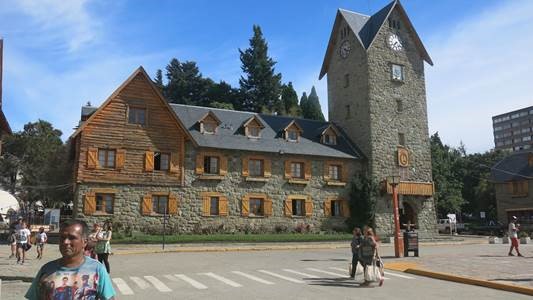
The town of San Carlos de Bariloche has no industry. It relies totally on tourism with two main seasons, summer hiking and touring, and winter skiing. Consequently almost every store is a café, a gift shop or sells chocolates. a local speciality brought in by early immigrants. The cocoa beans are imported from Brazil but the finished products are produced in town. There are a few interesting buildings including the Municipal Centre which dominates the main square. A European influence is noticeable, even down to the Saint Bernard dog with a Swiss flag painted on its barrel.


We played the tourist, taking a tour that included a chairlift that took us to the top of Mount Campaniaro providing 360 degree views of lakes, mountains and occasional dwellings. A visit to a small local business that produces rosehip oil was interesting and Kim purchased some more potions to add to her Harry Potter collection. 


We jumped from that tour directly on to a boat trip that took us to Isla Victoria, an island that boasts a well-established arboretum including some huge sequoias, douglas firs and a variety of native species, the names of which we could not pronounce. As the only English speaking passengers we were fortunate to have a guide, Sebastian, to ourselves, who took great pride in pointing out all the eucalypts. He also explained about the Arrayanes, a cinnamon-coloured tree that has a very thin bark that is rich in tannin and feels strangely cold to the touch. We compared it with other trees and the difference was considerable – another new experience.


Following the unusually calm day, the wind returned and the lake surface became choppy. Clouds obscured the sun giving the water the appearance of lead. But the scenery remained beautiful, if a little moody. The catamaran was comfortable and the gentle rocked sent both of us into a doze on the way back. The boat’s name, Cau Cau, which means seagull. Hope you’re impressed with the pic – it took ages to get!


We hired a car to visit the small town of Villa La Angustura, nothing to do with the bitters added to gin, and to see some of the Seven Lakes. These are linked and cross the Andes before becoming a river that flows right across the country, finally reaching the Atlantic.

Argentina produced some good wine, of which Malbec seems to be the favourite. We’ve enjoyed a bottle or several and perhaps this a good place to finish this with a rather fine example of a Malbec that sort of evaporated over dinner.


Friday, 1 March 2019

Not another Land Rover trip

I wasn’t planning on writing a blog for his journey.  It’s not Land Rover trip, although we do have some vague plans for something later in the year when summer is over and the weather becomes suitably cooler for travelling in a 24 year old Defender with no air conditioning.   We thought we’d have a holiday away but before we left I received complaints (not requests mark you) in the event that a blog would not be written.  So here goes.

This trip may best be described as one off the ‘bucket list’.  Since I was a teenager I’ve had hankerings to visit a certain place on this planet, never really thinking that it would actually happen.  But with advanced age, less daily responsibilities and a use-by date looming closer, it’s time to SKI (spend the kid’s inheritance).  It’s a bit of a trek from Australia but what the heck.  The destination?  Tierra Del Fuego and Cape Horn.

It’s odd how the brain works.  Preparations for cold temperatures and the very real possibility of howling gales will require wet weather clothing and warm layers.  In Brisbane it’s 34 degrees centigrade and the a/c is working hard.  Somehow it doesn’t make sense.  But preparations must be completed; warm clothing found or acquired, cases packed, dog relocated, house secured, Land Rover locked up, etcetera, etcetera.  With luck it’ll all fall into place before departure. 

I guess everything did get done.  We actually arrived at the airport even before check in opened, so that was a first. 

Flights from Brisbane to Auckland and then on the Buenos Aires were comfortable and the meals were probably the best we’ve ever experienced in the air.  So a big thanks to Air New Zealand.

It’s 7850 miles, fourteen and a half hours flying and 11 hours time difference in Buenos Aires.  The clocks told us that we arrived four hours after we left on the same day.  Confusing!  But after a quick shower we set out to see a little of the district known as Recoleta.  The Sunday evening bustle of families picnicking, promenading, eating and drinking was as colourful as it was fascinating.  Our few words of Spanish, coupled with a mini phrase book resulted in an excellent IPA beer, an OK malbec wine and a couple of pleasant light meals.  How did those English telephone boxes get here?


The local market was not too much different to most others, apart from a stall selling maté gourds and metal strainer straws.  Maté is prepared by steeping dried leaves of the yerba maté plant in hot water and is drunk through a metal straw from a shared hollow calabash gourd.  The brew does not look too appealing but the stuff seems to be drunk everywhere.  We did try it later and thought it rather like a slightly bitter herb tea.  We will not be talking it up on a regular basis.


Buenos Aires means ‘good air’ and indeed the city is very green with trees and shrubs everywhere.  However, the traffic is chaotic and so is most of the driving.  We’re told that it’s the Spanish influence.  Whether that’s an excuse or the reason we have no way of telling but for once I’m quite happy to be a passenger, although that can be alarming at times.

There’s a couple of famous people associated with Bueno Aires who should be mentioned.  There are others but I want to keep this blog short.  Firstly the Pope.  He hails from here and used to be the top man in the cathedral.  Fortunately we had a guide or we might have missed the place.  From the front it looks more like a bank but the inside, which has been enlarged and modified over the years, does look more the part.


Of course the other famous (perhaps infamous?) person is Eva Peron, otherwise known as Evita and brought to world attention through the efforts of Tim Rice and Andrew Lloyd-Webber.   She died at the young age of 33 and after several turbulent years, her body was finally laid to rest in the Duarte family tomb in La Recoleta cemetery where it is visited by devotees and tourists alike.  There’s a museum dedicated to the lady that illustrates some of her fashion sense in displays of her clothes alongside a whole variety of artefacts and documents.  I guess we’ll need to see the musical now to complete the experience.


There’s no shortage of entertainment in Buenos Aires whether it’s street music, colourful buildings in the La Roca port area or the tango.  It’s got to be done.  We expected a rather ‘touristy’ dinner and tango show, but it turned out to be an excellent meal and a show of non-stop energy and pizazz.  We’re not exactly experts on tango but can add that it’s quite exhausting, and that’s only watching it.  No pic unfortunately.  You’ll just have to take our word for it.

Take a large theatre and turn it into a bookshop cum library and you have El Ateneo.  It’s quite an attraction.  Certainly the largest selection of books we’ve ever seen for sale in one place.  Shelf upon shelf of books on every subject.  And the theatre boxes provide quiet reading rooms.  It’s a ‘must see’.


Whilst on the subject of culture, the opera house, known as the Colón Theatre, claims to have the finest acoustics in the world and is home, not only to opera but also ballet and orchestral works.  Impressive it is.  Seating around 2600 with another 500 or so standing, it’s a beautiful building that is well used throughout the year.


The time passed quickly and all too soon we’re at the airport ready for the next stage in our adventure.  Goodbye Buenos Aires, it’s been a great experience.

Wednesday, 3 October 2018

Land Rover 70th gathering

In 1948, the first Land Rovers appeared, initially considered a stop-gap vehicle to get the Rover company going again after the war.  No-one really thought that seventy years later, some of those very early models would still be running, and looking like new on the other side of the world.  In those intervening years, not only did the original Land Rover continue production, it developed a cult following and regular gatherings of enthusiasts are now to be found in all corners of the globe.  I guess it’s appropriate that 70 years should be celebrated.

In Australia, over the Easter weekend, a large gathering of over 900 vehicles quite literally took over the town on Cooma in New South Wales.  Unfortunately Kim and I were unable to attend that particular event but I did manage to make the smaller Queensland gathering in the town of Goomeri (population 664 on a good day) over the long holiday weekend in September.  Over 100 vehicles turned up, from a very early Series 1 right through to the last of the Defenders and some shiny new Discoveries. 

  
A fair sprinkling of military Parenties (the Australian built military variants) and some unusual rarities completed an eclectic collection.  For aficionados that really is a Tickford station wagon, rebuilt from a wreck and the only one in Australia.  And yes, we were one of only two Defender 90s!

    
The gathering was a grand opportunity to chat with other owners, catch up with friends old and new, and compare notes on modifications and adventures.

After a run of almost four hours and I arrived at the Goomeri Showground.  It took longer for me to set up camp than it usually does with Kim and I working as a team, but by early Friday afternoon all was in place and the kettle was boiling ready for a cuppa.  A procession of visitors asking about our set-up lasted until the evening when just for once I was obliged to drive the cooker and prepare my evening meal.  The obligatory pre-dinner G&T was accompanied by yet more visitors.  Everything worked well, even the old tank of gas that we’d used on our Simpson Desert trip lasted until the water was heated for washing up.  Swopping tanks took a couple of minutes, then everything was packed away apart from a glass of Shiraz on hand while I watched the sun go down and the stars appear.

On Saturday I did something I’ve not done for ages, sat down and read the newspaper from cover to cover.  A wonderfully relaxing start to the day.  Then it was time to take a look at the other Land Rovers, join in some chat about things going wrong – and things going right, picking up a couple of ideas for future projects and generally finding out how others enjoy their Land Rover hobby.

As several hundred of finished our dinner on Saturday evening, storm clouds gathered and it was not too long before flashes of lightning and the ominous sound of thunder heralded the imminent arrival of a tropical storm.  There was just enough time to roll up and stow the awning, and pack away the chair before it was upon us.  Lacking the incentive to return to the remnants of the post-dinner gathering I rapidly climbed the ladder and took shelter in the rooftop tent, but not before a fine collection of mud had attached itself to my boots.  But at least I was dry and it gave me time to catch up on a few chapters of my book.

The Sunday morning sky was threatening with voluminous black clouds filling the sky.  I had to pack up the tent to join the parade of vehicles filling the showground so that they could be filmed by a drone – and a great many other cameras too.  Large drops of rain began to fall and so I decided it was time to head back south rather than spend the rest of the day in a muddy field, a sentiment shared with quite a few others.


Four hours later, after a mainly wet drive and a stop in Blackbutt for a rather splendid steak pie, Vin Rouge was parked outside the house and I was getting on the outside of a large beer.  Sadly a shortened ‘long weekend’, but an enjoyable one shared with a lot of fine Land Rover people.