Friday, 18 September 2015

Wind and flowers

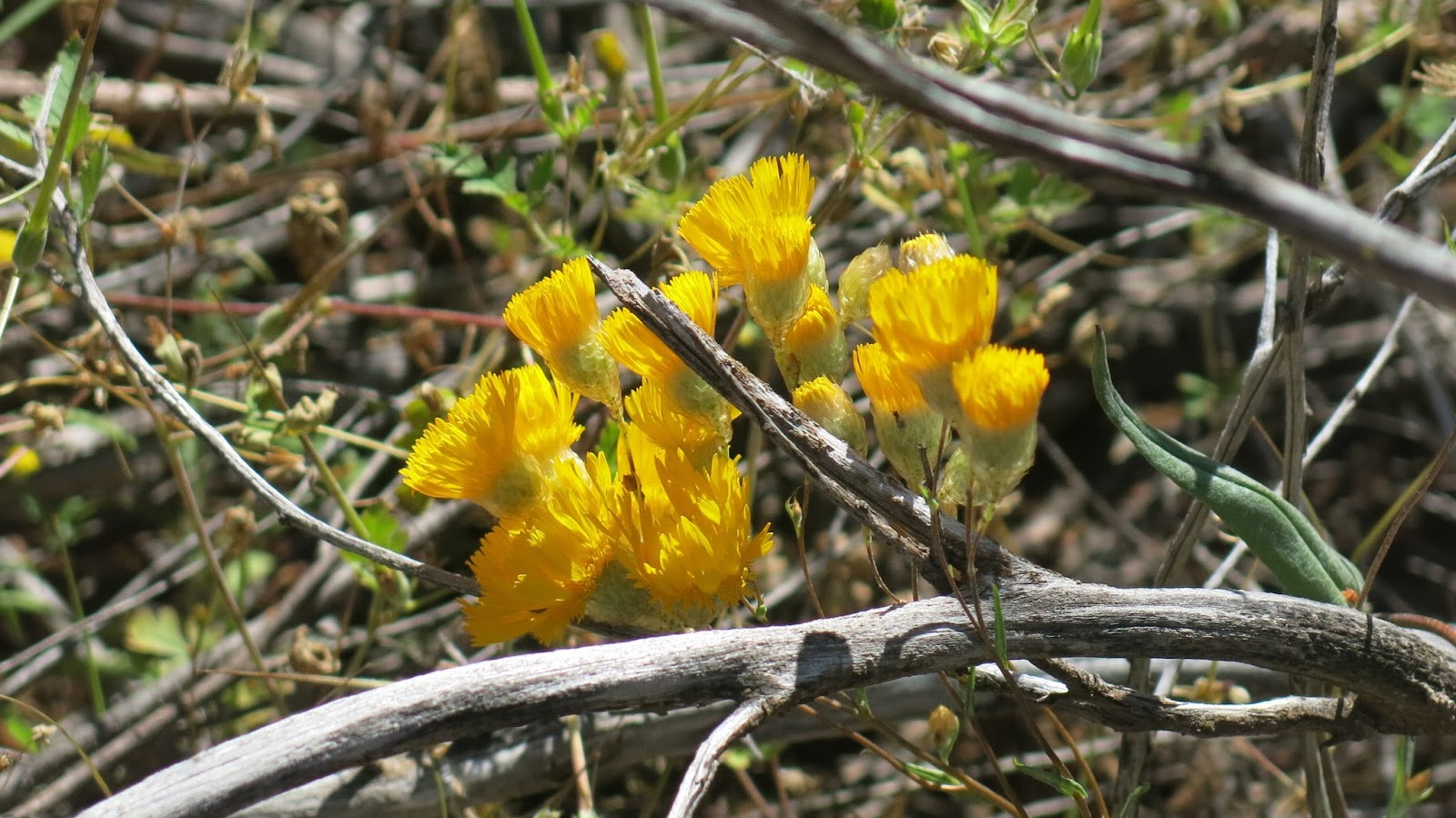
Another name for the wind flower is the anemone, which must be one of the few flowers we’ve not seen.  Whilst Kim has been impressing people with her knowledge of the Latin names for many of the species, Mike’s categorisation is a great deal less complicated (red, yellow, blue, white and other).  But there’s no denying that the swathes of colour spreading across the fields is a remarkable spectacle.


So we’ve seen the flowers and we’ve also experienced the wind.  Greenhough is the most windy place in Australia and so is much of the nearby coastline.  This is just one of the trees growing almost horizontally as a result of the constant westerly winds.  Vin Rouge was being thrown about in the gusts, which is very unusual as it’s a heavy vehicle, and Mike was getting very fed up fighting the forces of nature.


High winds and roof top tent living are not the best of partners so we diverted inland, passing some 70 giant electric generating windmills at the Walkaway Wind Farm.  Naturally Kim found a lot more wild flowers to stop and photograph along the way.  Edging back towards the coast we reached another of those weird Australian phenomena know as The Pinnacles.  Thousands of naturally occurring columns were once buried beneath layers of sand, but centuries of wind have exposed them and created a sandy desert surrounded by bush land.  The whole place has a strange, almost eerie feel about it.


But the wildflowers beckoned and we wanted a night free from gales and so it was foot hard down to Moora, a small town amongst some hills and out of the wind.  However, we’ve noticed that  the temperature drops quite noticeably each evening now we’ve travelled south and so we’ve reverted to our old favourite central heating system – the hot water bottle.  Tucked under the duvet (called a doona in Australia) it warms the bed.  On top it warms the tent.  A comfortable night results.

The Western Wildflower Farm we found a delight.  Kim was in her element finding about how the flowers were cut, dried and packed before being exported to Europe and Africa.  We even had a free cup of coffee.


The farm, in addition to producing 15,000 acres of flowers, also raises sheep and Mike had the opportunity to get away from flowers for a while to watch the seasonal shearing.  Four shearers were going flat out keeping another four sorting, compressing and packing the fleeces.  It looked, and must be, very hard work.


Our next stop, the Chittering Wildflower Festival at the small town of Bindoon.  The displays were grand and Kim was thrilled to find this specimen very appropriately named the Enamel Orchid.  It really does look as though it has been given a coat of gloss paint.


Mike by now was getting rather ‘flowered out’ and wanted a bit of a change.  The town of New Norcia is Australia’s only monastic town having grown from a missionary in the 1850s.  Now largely a tourist attraction with a certain amount of educational content, it proved to be an interesting tour among the European style buildings.  It’s history may be interpreted many ways but there’s no doubt that the Benedictine monks acted on what they thought were the best principles at the time.  We just enjoyed the architecture.  To avoid getting into the dubious subject of religion, I’ll finish here with a fine view of St Ildephonsus College.  No, we don’t know how to pronounce it either!
  

Wednesday, 16 September 2015

Flower Power

Think of the Australian Outback and you think of naked red dirt with a few scrubby bushes, some stunted trees, spinifex and the occasional spot of colour.

Spring in Western Australia comes as a huge surprise. Acres and acres of wild flowers, hundreds of species and a bewildering array of colour. For several years Kim has wanted to see the spring blossom (she is a trained florist after all) and our route was timed to make the most of the spectacle. Given that pictures speak much more than words, I’ve included a selection (although they don’t really do it justice) and leave you to decide just how good they are.


One plant I really must emphasise as it grows only near to the town of Mullewa is the ‘wreath flower’. Take a look at these and you’ll see where the name derives.


We’ve been amazed at what we’ve seen. We expected colour but didn’t expect the variety and certainly didn’t expect the quantity. It’s been a real highlight.

Sadly, in a few short weeks, the colour will be gone and all that will be left will be naked red dirt with a few scrubby bushes, some stunted trees, spinifex and the occasional spot of colour. But hidden in that red dirt will be the seeds ready to burst into life next spring when the rain has done its magic.

Saturday, 12 September 2015

Heading South

Somewhat reluctantly we left T-Bone Bay and the Cape Range National Park, stopping over in Exmouth to stock up and fuel up.  We dined on rather large and delicious prawns and found one that looked as though it might like to dine on Vin Rouge!


Travelling due south for the first time we left the Exmouth peninsular, rejoined the North West Coastal Highway and crossed the Tropic of Capricorn.  For the first time in weeks we’re out of the tropics and into the sub-tropics. 


Southward over the 26th Parallel we officially left the North West for the West.  Nothing much changed.  The road was long and straight with the usual scrubby bushes, but slowly we noticed change.  Spring flowers were appearing, sometimes just a few of them, sometimes great swathes of colour, yellow, magenta and white contrasting strongly with the red earth.  Most noticeable were the abundant lilac-coloured Mulla-Mulla which we understand translates from the local Aboriginal dialect as “pretty but useless”. 


We stopped briefly at Coral Bay but found it not to our liking – too much commercialism and crowds of people – and continued to Carnarvon, a run of almost 400 kilometres, which is about as far as we really want to travel in a day.  Here we struck it lucky.  Acting on a tip from the tourist office we arrived at the Outback Oasis Caravan Park to be warmly welcomed.  We vote the Park as the best we’ve experienced on our travels.  A good site, excellent amenities and the friendliest of staff.  Well done all.

The next day finds us once again piling on the k’s as we make for the Shark Bay peninsula and the little town of Denham.  Denham has a friendly seaside atmosphere.  Even the sky put on a show for us. 


It’s the most westerly town in Australia and the Shark Bay Hotel, more usually known as The Old Pub, is the most westerly drinking spot.  Of course we paid a visit, enjoyed a hearty meal and a couple of drinks, celebrating that were about as far from Brisbane as it’s possible to be whilst still in Australia.  The outward bound part of our adventure is complete.  Now we’re on our way back home.

The area abounds in oddities.  Firstly there’s cockles.  Not your usual cockles that we’ve eaten soaked in vinegar, but tiny Fragum Cockles, less than a centimetre across.  Millions of these creatures survive in the waters of Shark Bay, which is twice as salty as the surrounding ocean because the sea evaporates rather than ebbing and flowing.  With no predators the colony has built up over thousands of years forming deep layers of shell that fuse together with the mildly acidic rain.  Blocks of the stuff, known as coquina, have been quarried for building.  We rather liked the restaurant, built by one man over a period of four years early in the twentieth century.


Another oddity is Stromatolites.  We can’t claim to really understand what they’re all about, but suffice to say that they are one of the earliest and most primitive forms of life (a bit like that Toyota driver really!).  To us they looked like black rocks.  I’m sure a geologist would be much more excited.  Hamelin Telegraph Station is where all these are to be found, together with another more modern oddity.  We enjoy the occasional scone and the ones served up came with the usual strawberry jam and cream.  However, we’re remain to be convinced that a background flavour of cheese was really to our taste.

We were impressed with the memorial to the ship and crew of HMAS Sydney, sunk in 1941 by the German Raider HSK Kormoran, disguised as a Dutch merchant vessel. 


Dolphins visit the strangely-named Monkey Mia, a short drive from Denham and we watched as half a dozen of these graceful creatures gently took fish from the hands of
willing volunteers.


So far we’ve clocked up over 15,000 kilometres.  It should be a shorter trip back.

Tuesday, 8 September 2015

I must go down to the sea again . . .

We’ve made it to the west coast, that is, a long way further west than the last bit of west coast.  Exmouth to be precise.  We did meet one bonehead in a Toyota who said “you got here in That?” nodding in a derogatory fashion in the direction of our Vin Rouge.  My response was that I wondered if his vehicle would still be running when it was twenty years old.  Grrr!

Exmouth sits on the eastern side of a promontory and is 700 kilometres south west of Tom Price.  There’s not a lot here, just a couple of caravan parks, a few shops, an impressive visitors centre and a few houses.  Tourism is its main bread winner with a bit of fishing on the side.  Its claim to fame is Ningaloo, which the west coast considers to be their answer to the Great Barrier Reef.  It’s nothing like as big but does have the advantage that coral reefs begin just a few yards from the shore.  The government created Cape Range National Park to provide a bit of control and typically they’ve gone a bit over the top.  Notices everywhere state that the are ‘no campsites available’.  The requirement is to queue up at the Ranger Station at 8am to be allocated any space that might have become available.  True to form, we rocked up about half past ten to be told that plenty of sites were free, although people had been turned away earlier.  Bloody bureaucracy getting in the way again!

So here we are in the quaintly named T-bone Bay.  First we have to set up camp.


Here’s the view from our camp looking seaward (and yes, the sea really is that colour).


Looking landwards we get quite a different but another picturesque view.


An in a different direction, another view entirely.


This is the ‘facilities’, otherwise known as the Great Australian Dunny or ‘long drop’ (work it out yourself).  It may look primitive but it’s actually quite high-tech and most hygienic.  However, Kim on a night-time excursion did find the sort of spider that could quite easily wear boots, but it wasn’t bothering anyone and so it was left alone to do whatever large spiders do in the dead of night.

Next morning we found ourselves the sole tenants of the entire bay.  The only footprints were ours and the pristine sand squeezed between our toes as we made them. 


The water was almost warm and so we took to snorkelling over the reef where we found coral heads, a variety of small but colourful fish and an octopus lurking in a hole. 

We liked the place so much we stayed two nights, relaxing, snorkelling, eating well and imbibing the occasional but necessary shandy to keep cool.  After all those corrugations and dust we felt we deserved it.  We even had visitors, a friendly kangaroo that seemed to be enjoying its herbivorous meal three metres from where we were sitting, some assorted birds making a racket in the trees and some teasing trail marks left in the sand by a goanna and some sort of snake. 

In short, a little bit of paradise.

Sunday, 6 September 2015

Mine All Mine

As we’ve progressed southwards, we’ve noticed that the temperature at night has been dropping noticeably, with a special little dip just before dawn around 6am.  That’s when the alarm woke us and we packed up the tent in the semi-light to ensure that we’d be ready for the 8 o’clock Rio Tinto mine tour starting from the town of Tom Price.  The town exists only because of the iron ore mine which is named after the American geologist who carried out some of the first trials in the area to determine whether mining was commercially feasible.  Apparently he reported that the area could supply about 80 per cent of the world’s needs.  That was back in the early 1960’s.  Mount Tom Price was also named after the man and ever since Rio Tinto has been removing it. 

The whole operation is mind boggling enormous.  Some 360 million tonnes of iron ore is removed each year, crushed into small pieces and exported, mainly to China, Taiwan and Korea.  What was once a mountain is now an enormous hole in the ground.  Look carefully and you’ll see a ‘Tonka toy’ truck down there.


Now that ‘Tonka toy’ is not a toy at all.  It can carry 240 tonnes of ore and has tyres almost two metres in diameter.


The digger that loads it takes just eight scoops to fill a truck and 36 of these trucks works 24 hours a day.  We’d already seen the 2.4 kilometre long trains that transport the ore to Dampier for loading onto ships.  Even the rail system with 1,600 kilometres of track is Australia’s largest privately owned network servicing 15 mines.  Here we saw the trains being loaded by a giant scoop and conveyor system.  It takes just one and a half hours to fully load a train, by which time the next one is waiting.  As I said, the whole operation is enormous.

Tom Price and the nearby mining town of Paraburdoo are our last places of call in the Pilbara.  I should have mentioned this name earlier.  The Pilbara is the large, sparsely populated region in the north of Western Australia known for its ancient landscapes, red earth and vast mineral deposits.  We’ve seen quite a bit of it, brought a lot of red dust with us and are now at last heading for the coast.

The road from Tom Price to Exmouth is over 600 kilometres of unchanging scenery.  The most exciting part was when we stopped for a cuppa and watched a couple of budgerigars.


Otherwise it looked like this.


What with leaving late, we didn’t complete the journey in a single day so free camped overnight in a rest area (toilets but no showers) arriving Exmouth about noon.  Instead of all that red dust we can see the blue Indian Ocean.

Friday, 4 September 2015

Travelling

The road from Broome to Port Hedland can best be described as 600 kilometres of monotony. We drove it over two days, decided that Port Hedland was not for us and moved rapidly on another 250 kms to Karratha. There’s nothing of note from the journey to describe, so instead, as mentioned few blogs ago, I’ll describe our camping set up.

Vin Rouge, our Land Rover Defender 90 is a very small vehicle. There’s little space and so everything has to be packed in carefully. We don’t live in Vin Rouge, rather we live on and around it, which is fine if the weather is good. You’ll have seen pictures of us as we’re travelling. The roof top tent sits on the roof rack, so does the ‘washing machine’. The awning hangs on the passenger side and apart from the gas bottles on the back, that’s about all you see.


Setting up camp takes about ten minutes. Firstly the tent is opened up. It simply unfolds, similar to opening a book, over the back of the vehicle. The ladder is used as a lever to make the job easy. Next the awning is opened. Two strong arms fold out from the roof rack to support the canopy (there’s no poles). The galley folds out from the back door. A two burner stove and grill drops into place, the gas supply simply plugs in and it’s ready to go. Lastly the water supply is connected to the tap under the stove. Job done. Kettle on and we’re ready for a cuppa. All the domesticals are in those two drawers which also provide kitchen work surfaces and a chopping board. The only extras are two folding chairs and a table. Packing up takes about ten minutes, a bit quicker if it’s raining!.


When the weather is being unkind, or we need some privacy, we add walls to the basic set up. This makes a two-storey tent. It’s not huge, but provides sufficient space for our needs and protects us from the elements.


Storage is of course limited. We have twelve boxes; six of them hold clothing, shoes and swimming gear. Three are for food, and there’s one each for toiletries, laundry and the odds and ends. These stack in three columns of four boxes so it’s a trade off as to which goes on the top for easy access. The fridge runs off a second battery as do the LED lights built into both arms of the awning, in the tent and under the tent.

As Kim says, it’s basic but sufficient.

Now back to our travels. At certain times when the moon and tide are aligned, a phenomenon occurs that’s known as the ‘staircase to the moon’. It’s visible from a few places on the west coast of Australia and we were fortunate enough to see it on the 30th August just outside Karratha. As the tide ebbs, mudflats are exposed and as the moon appears to rise from the sea, this is the effect, although the photo doesn’t really do it justice.


Next day and we’re at Dampier. If you’ve seen the film Red Dog, you’ll know of it. If not, try and find the DVD, it’s a different sort of movie and one based on fact. There’s even a statue in town dedicated to the dog.


Dampier is a seaport where hundreds of thousands of tons of iron ore are exported each week. Much of it arrives by train and we obtained a permit to drive the Tom Price Railway Road that runs alongside the railway line. It’s a dirt road, but generally a good one, if dusty. The trains rumble by at regular intervals. We tried to work out how much is carried on one of these trains with three engines taking the load. Told that each wagon holds 200 tons, we tried counting the wagons but when the train is 2.4 kilometres long, our counting failed long before the train passed by. Whatever it is, it’s a big, big number.


Diverting from the Tom Price Road into the Karijini National Park we first stopped off at Hamersley Gorge for a quick look at the amazing volcanic rock formations. Look carefully and you’ll see a couple of people in the photo. It’ll provide some sense of scale – and the picture shows just a small part of the gorge.


Overnight we camped in the park where the southern hemisphere provided its usual dazzling display of stars. No pics, you’ll just have to take my word for it.

We thought the scenery in the Karijini National Park as lovely as we have seen anywhere. Deciding to stay a couple of days, we visited Fortescue Falls, the really beautiful Fern Pool, took some walks along the rim of several gorges and wondered at the extraordinary rock formations, laid down 3,500 million years ago. Apparently it’s some of the world’s oldest visible land. Oxer Lookout is reckoned to be one of the most scenic spots in Australia and it would be difficult to disagree. The pictures don’t do it justice but here goes.


It’s Spring in Western Australia and wild flowers are in bloom. We haven’t yet reached what we understand are the best places to see them but have been really pleased with what we have seen so far. More about flowers later but here’s just one for a sample. It’s called Sturt’s Desert Pea. It’s rather a favourite with us.