Tuesday, 21 July 2015

The Never Never

Jeannie Gunn wrote a book ‘We of the Never Never’ about her life on an outback cattle station in 1902.  That cattle station was south of Katherine and the book has become something on an Australian classic.  We found the reconstruction of her home, Elsey Station Homestead, and wondered at the hard life that people lived at that time.  Our journey into the town of Katherine took a few hours.  In 1902 it took four days – each way!  We also found the graves of some of the characters mentioned in her book, including her husband Aeneas Gunn and the ‘postman’ affectionately known as ‘The Fizzer’.  Having read the book, we found it fascinating to see the places mentioned.


We reckoned that was sufficient culture on a hot winters’ day so adjourned to the nearby Bitter Springs Thermal Pool and gently soaked in the crystal clear warm water, drifting slowly with the stream as it emerged from an underground spring. 


Overnight camp was at the Mataranka Homestead, and as it was Kim’s birthday we ate at the outdoor restaurant and watched the evening entertainment – Nathan Griggs who, apart from being the world’s faster whip cracker has developed an act around his skill.  His finale with two flaming whips was as unusual as it was spectacular.


The town of Katherine is not large, but it does have a Woolworths (Aussie supermarket for overseas readers).  After a couple of weeks of outback stores where the range is minimal and the prices are staggering, Kim took time out to enjoy perusing the shelves and we stocked up on fresh provisions with only Mike’s famed ability to pack a quart into a pint pot allowing all that needed to be stacked in the fridge to actually go in. 

You’ll recall that we’ve been travelling with our two American friends, Glyn and Chuck in their Defender 110.  Unfortunately Chuck has developed something that he calls a ‘bad back’.  It seems he’s suffering from a trapped nerve that is causing him a great deal of pain, we suspect a great deal more than he’s saying.  Camping in a tent is not ideal and with a bit of probing we’ve collectively found him cabins with proper beds for a couple of nights whilst Glyn and his comprehensive medical kit has provided a supply of pain killers.  As a temporary solution it’s enabled Chuck to get by for a while but he’s managed to arrange a flight to Sydney a couple of days ahead to be with his son and family and so today (Monday 20th July) we parted whilst Glyn took Chuck to Darwin for his flight.  We wish him well and hope that he can find a remedy to an extremely debilitating condition.  Good luck Chuck, we’ll be thinking of you.  We’re planning on meeting up with Glyn in a day or so and will again travel in convoy for a while.

People visit Katherine to see the gorge, otherwise known in the aboriginal tongue as Nitmiluk, or ‘place of the cicadas’.  Our trip took in two of the gorges, carved out by tens of thousands of years of flooding and weather erosion but we neither heard nor saw a single cicada! 


We did however, see a trap for estuarine crocodiles, but we didn’t see any of those either, although a fresh water croc did pop its head up but decided we weren’t really interesting.


Day turned to night, quickly as it does in the tropics and we enjoyed Kim’s special creation of Gado Gado al la Vin Rouge.  On that note I’ll wish you well and relax before turning in comfortably in our rooftop tent.

Sunday, 19 July 2015

Westward Ho

The Savannah Way is not a single road.  There are what is known as ‘alternative routes’ and of course we had to check these out.  The tracks are of course dirt roads and generally rougher than the main tracks or roads.  So we continued with the dust and more or less gave up trying to keep clean.  We crossed dozens of creeks but only a few had any water in them.  However, the driving was demanding with being on constant alert to avoid potholes, sharp stones, bulldust pits and washouts.


Slowly the scenery changed.  We noticed that termite mounds differed in size, shape and colour.  Eucalypts varied from large to stunted, whilst grasses varied from tall, sharp and spiky to very dry and sparse.  Of wildlife we saw little - a few groups of undernourished cows, a few feral pigs, a couple of buffalo, a kangaroo or two but quite a lot of black kites and huge wedge tailed eagles feeding on road kill.

Our next diversion through the newly created Limmen National Park which is situated just south of Arnham Land revealed the roughest roads we’ve yet experienced.  We again travelled in convoy with Glyn and Chuck which provided an extra safety net in case of problems.  Happily, neither of us had any real problems, the only issues being a stone guard on our rear wheel breaking up, Glyn picking up a slow puncture and quite a few screws and bolts loosening up with the corrugations.


The Lost City conjures up mental images of ancient buildings but it turned out to be strange rock formations.  Strange they most certainly are.  Carved by millennia of wind and rain and flood, they form grotesque shapes soaring into the sky.


On again.  Miles and miles of corrugations until we arrived, tired and saddle sore at Towns River. Ah, what a sight.  Tranquillity, a camp fire, a couple of beers and a good meal and the world starts to look a lot better whilst the trials of the day become the tales of tomorrow.  Is that what travelling is all about?  I wonder!


There are a few road signs in the outback.  Lots of these.


This one we found amusing.


Then suddenly, after ten days of dirt tracks we experienced the novelty of a genuine macadam road surface.  And that’s where I’ll finish this little blog, sitting back and luxuriating along at 90kmh on a smooth road surface.  Bliss!

Friday, 17 July 2015

Up the creek

Karumba is known for its seafood and didn’t disappoint.  We indulged in large portions of wild barramundi and chips which tasted infinitely better than the farmed variety available in Brisbane.  Taking a kilo of fresh prawns for dinner we back tracked to Normanton to refuel and take on some provisions.  There’s no choice, that’s where the road goes. 

You may recall from a couple of blogs back that we had met Glyn and Chuck at Musgrave.  We met up with them again and travelled together, overnighting at Burke and Wills Roadhouse and on to Adel’s Grove, both spots in the middle of nowhere.  Adel’s Grove was first settled by a Frenchman, Albert de Lestang from where the place takes its name.   He created a experimental nursery and provided seeds to many of the world’s great botanical gardens.  In the early 1950s the place was accidentally burnt out and all the records, plants and stores were wiped out.  Not surprisingly Albert fell into depression and died shortly afterwards but his legacy lives on through his contribution to the world’s hybrid plants.

Camping amongst mature trees provides a shady environment and we relaxed the afternoon away.  Next morning we paddled a couple of canoes along nearby Lawn Hill Gorge delighting in the scenery and lush greenery until we reached a small waterfall.  Carrying the canoes a hundred metres or so we re-launched and paddled until we reached a second set of falls, then turned back


With the breeze and flow of water under us we made rapid progress to where we needed to carry the canoes at which point Glyn and Chuck’s canoe suddenly overturned.  No real drama although Glyn did manage to lose his sunspecs.  Full of compassion, Kim took photos!


The camp fire that night was as camp fires should be – creating an atmosphere conducive to relaxed discussion when the world’s problems were reduced to a magnitude that could be resolved.


Next day and we’re travelling with Glyn and Chuck in convoy on the dirt tracks, with a few creek crossings to take our mind off the corrugations.   The scenery didn’t change much.  Mile upon mile of scrub, hard stony tracks, a few scrawny cattle, dried up creek beds, termite mounds and dust.  Dust as we’ve never experienced before.  It infiltrates everywhere until the inside of the car is as dirty as the outside, and the occupants are as dusty as the car.  Mouths feel gritty, eyelids too.  Skin is dry and papery.  Everywhere is arid.  It’s winter in northern Australia.


We overnight at Hells Gate Roadhouse.  There’s nothing there but a couple of buildings, a fuel bowser and for some reason not particularly apparent, an airstrip.


Next day, more of the same and we in due course reach another State, the Northern Territory.  So I’ll leave this blog in the dry and dust and resort to a cold beer from the fridge.

Tuesday, 14 July 2015

Savannah Way

The Savannah Way spans Australia from Cairns in the East to Broome in the West, a distance of some 3,700 kilometres. It passes through three States, crosses the base of the Cape York Peninsular, skirts south of the Gulf of Carpentaria, edges northward to Katherine, then southward and west to finish at Broome on the West Coast. 

Having returned to Cairns, we started out at the beginning of the Savannah Way, making a brief stop at Ravenshoe. It was here you may recall that tragically two people
died not many weeks ago when a truck ran into a gas cylinder at the back of a cafe creating an explosion and fireball.  The place had a sad feeling, emphasised by notices appealing for any information about the loss of wedding rings.  By comparison our overnight stop at Undara was a delight.  A camp fire in the bush, fantastic sunset and ‘bush television’ for entertainment.


Up early Wednesday morning (8 July if you must) we joined the tour to visit the lava tubes.  Now Australia isn’t the first place that comes to mind for volcanoes but these are of a slightly different variety.  We didn’t know there were different varieties either!  Not mountains but more like very large pimples on the landscape, the area surrounding Undara is peppered with small craters.  We walked around the rim of the Kalkani Crater, about 2.5 kilometres, with every step offering distant views over the bush landscape. 


The Undara volcano lava tubes are not quite unique, but they are the largest in the world being some 75 metres in diameter.  The tubes were formed about 190,000 years ago by lava flowing at a certain speed, not too fast and not too slow.  The relatively flat landscape created conditions ideal for this.  The top layer cooled because it was exposed to air allowing the molten lava to flow underneath.  Eventually the lava stopped flowing through which created the tube.  Thousands of years of erosion created some openings and that’s how we got in.


Westward again on tarmac for a change passing through the old gold mining towns of Georgetown, Croydon and Normanton.  Our overnight stop again produced an amazing sunset and it was free camping behind a small stand of eucalypts set back about 50 metres from the main highway.  Seven vehicles passed by during the night. it’s a pretty quiet main highway!


Breakfast of egg on toast was not entirely successful when one of the eggs declined to cooperate and broke in the back of Vin Rouge, by which time we’d cleaned it up the other egg was, shall we say, well cooked!  But a second cuppa, some toast and ginger marmalade set us up for the road.  At Black Bull Siding (don’t look for it on your map!) we came across The Gulflander.  This train’s claim to fame is that it goes from nowhere to nowhere, (Croydon to Normanton actually) taking two days to do the journey we completed in a few hours. 


On again to Normanton where at almost nine metres long and weighing virtually 2 tons, the largest crocodile ever known was shot by Krystina Pawlowski in 1957.  There’s a replica outside the Shire Council Offices and that’s quite scary enough.

Our final stop for the day is Karumba, a small coastal town where barramundi and chips for two set us back $20 and there was so much we couldn’t finish the meal.  Replete and lazy we watched the birds.  Dozens of black kites circling in the thermals, pelicans and a brolga in the sea, corellas and other parrots squawking in the trees and on the ground.  We were also buzzed by a plague of locusts (is that the correct term?) around the camp.  The things look like giant grasshoppers but have wings and fly quickly in every unexpected direction.  Their navigation isn’t too good as they seemed to have a preference for flying into Kim.

Yet again a magnificent sunset.  This time we viewed it over the rim of a glass looking out to the seascape of the Gulf of Carpentaria.

Friday, 10 July 2015

For the sake of a toothbrush

There’s something about the ritual morning cleaning of teeth.  It’s a part of life that doesn’t really figure greatly – until the toothbrush goes missing.  If, like us, you’ve progressed to the electric toothbrush then a flat battery amounts almost to the same issue.  Scrubbing away with a miniscule brush head that used to whir just isn’t the same. 

Charging is not a problem.  We have either a 12 volt supply that looks after the computer, cell phone and satellite phone, and a small converter to create mains power for the toothbrushes and my shaver.  So one guess as to who left the toothbrush charger behind!

No problems, we thought.  We’ll simply buy another.  Now in the wisdom of the manufacturer, they don’t sell chargers separately.  OK, we thought, we’ll simply buy another toothbrush – that cheap one on special offer will do and we’ll have an extra head and body if we really need it.  So who gets the only one in the shop with a duff charger?  Yup, you’ve guessed it.  As we’ve moved on, the only safe alternative is to get our daughter Sarah to mail us the charger we left behind.  Today we picked it up from Cairns Post Office and can once again clean our teeth with impunity.  Hooray!

Before leaving Cape York we visited Split Rock near Laura.  It’s quite a hard climb to reach from the road but well worth the effort.  Cave paintings dating back about 13,000 years (yes that is correct) remain.  They’re not really ‘art’ in the accepted sense, rather some sort of impression  of what the people of the time felt they needed to record.  There’s fruit bats, a turtle, people and what were considered ‘spirits’.  It’s all very interesting and we were the only people there.


Rather more modern history is presented in the old town of Herberton.  The place is preserved as it was in the late 1800s through to the 1920s.  On the revenue from gold mining the town grew rapidly and boasted a variety of stores including a pharmacy, grocery, butcher, farrier, cart maker and bakery.  Later additions were a garage and a cinema.  I was interested to find that the projector used until 1986 was a Simplex – the company I first worked for back in 1959.


It’s now time to head off west, following the Savannah Way right across Australia.  There’s not many towns until we reach Darwin and so we return to Cairns to complete our shopping.  With Vin Rouge filled with fuel, water and provisions, toothbrushes charged and we’re on our way west.  First stop, not too far away, is Ravenshoe (apparently that’s Ravens-hoe, not Raven-shoe) where we see lush pastures and fat cows grazing.  It won’t be long before the landscape becomes a lot more arid.


Oh yes, that toothbrush thing again.  It turns out that the converter is burning out the chargers.  There’s no other option but to invest in a couple of old fashioned manual brushes.  At least nothing can go wrong with them.

Sunday, 5 July 2015

The Impromptu Land Rover Club

We’re members of the Land Rover Owners Club of Brisbane and hoped to meet up with them somewhere on the way to Cape York as a contingent was making its way to the top a couple of weeks after us.  However, it seems we managed to miss them but we’re sure they are having a great trip and will write up their adventures in the club magazine.
 
After another dusty day we pulled in to the Musgrave Roadhouse to camp for the night.  Almost immediately another Defender followed us in and parked behind us.  We noticed that it had British registration plates and were intrigued to find out more.  We learned that it was owned by Glyn, a softly spoken Californian Englishman who’s hobby is driving in unconventional places.  He’d driven across most of Africa and had many adventures including having the vehicle half submerged and after recovering it, getting the water out of the engine, starting up and continuing the journey.  With Chuck as navigator they’re touring around Australia.
 
 
And another LR arrived, this time with two incredibly dusty occupants, Cameron and Robert.  Their very new Defender 90 had really been put through its paces having started from Hobart in Tasmania.  They’d travelled up the Old Telegraph Track, rather than taking the bypass road as we had done (for which I claim a seniority and dotage).  They made it through in one piece taking the rough patches in their stride and getting pretty mucky in the process.  Best wishes Cameron to you and your wife on the pending new addition to your family.
 
 
We had a drink and talked at length about Land Rovers.  We compared notes on why we preferred them to other 4WDs and looked at the different ways that each of the vehicles had been prepared for their respective uses.  We exchanged contact details and swopped recommendations on places to visit and places to avoid.  A typical club meet really when complete strangers become friends.  It’s the way with Land Rover people – the Impromptu Land Rover Club.
 
 
Then we went our separate ways.  Glyn and Chuck to The Tip, Cameron, Robert and us travelling south.  On the way we spotted this monitor lizard.  Almost as large as a man, it doesn’t really qualify as a member of the ILRC.
 

Red Dust

We’ve reached the top and had to stop and now must go back the way we came, at least for a while.  Fortunately navigator Kim finds an alternative route out of Bamaga that eventually leads us back to the Peninsula Development Road (track) that is the only way to and from The Tip.  Once again we take the mini-cruise across the Jardine River (it’s free this time!) and follow the corrugations south until we turn off to see the Eliot Falls. 


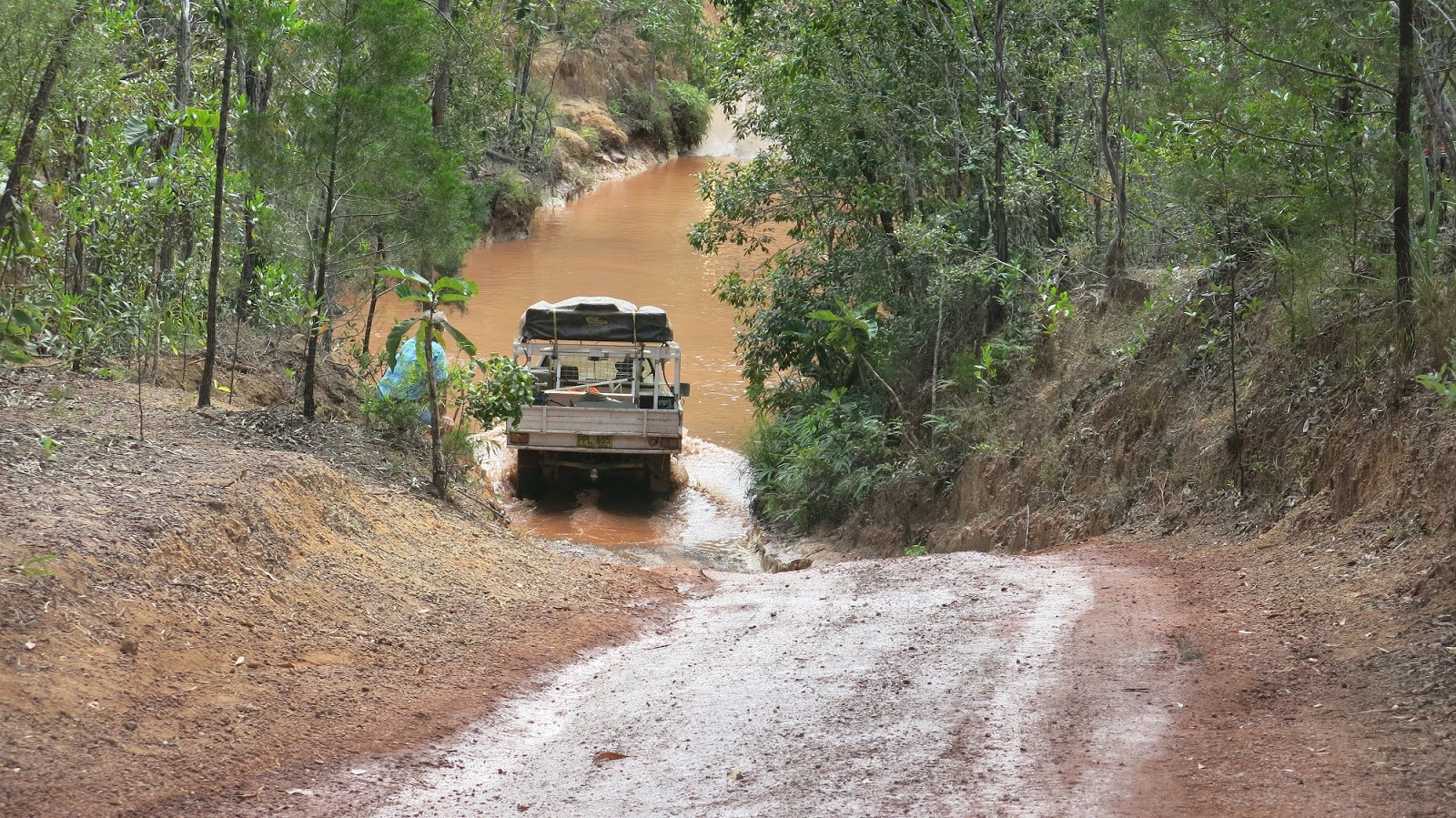
Eight kilometres down a heavily rutted track that crosses one flowing river later we reach the falls.  This has been the only section of our journey so far that might be described as a bit challenging.  For the first time we engaged the difflock and dropped to low range to make it across the muddy river that was about as wide as the Jardine Ferry crossing.  About a metre in its deepest part it sloshed water over the bonnet.  Our pristine new homemade ‘bonnet bra’ worked well, keeping the worst of the muck out of the radiator.  Note to self, close window before negotiating deep water crossings!


Then south again, stopping only briefly to get a shot of just how big some of these termite mounds can be.


I really must take a short deviation here to describe the dust.  Blog stats tell me that we have followers not only in Australia but also in the UK, USA, Ukraine, Canada, Germany, Netherlands, Palestine and Portugal.  Welcome all and we hope you enjoy sharing our little adventures.  If you have never driven in far north Australia, let me try to describe the dust.  To get an idea, take a full tin of talcum powder, give it a shake to loosen up the contents, then gently sprinkle the whole lot in front of a fan running at full speed.  For the full effect, do this in your bedroom.  Wait a couple of minutes until you can see across the room and then examine every surface, nook and cranny.  You’ll find that the powder has penetrated everywhere, into every minute gap and onto any surface, flat, curved, horizontal and vertical, on the top, sides and underneath.  It’ll be stuck to everything, especially anything remotely greasy and anything with a static attraction such as plastic.  Now imagine that this powder is not white, but a deep rust red that stains anything white.  You now have some idea of what the inside of Vin Rouge looks like after a day on the road.  And some idea of what the occupants look like too.  There is a bonus.  After a day on the road you really do appreciate a hot shower!


The corrugations in the tracks have had their little victory.  Two of the plastic tabs that hold the instrument panel in place have broken and so a ‘bush repair’ using gaffer tape is effected.  That should last a few months until we get back to Brisbane and make new parts. 


We overnight at the Old Morton Telegraph station where Kim cooks up a mean risotto using the last of our fresh provisions.  Delicious.  Tomorrow it’s more dirt roads.